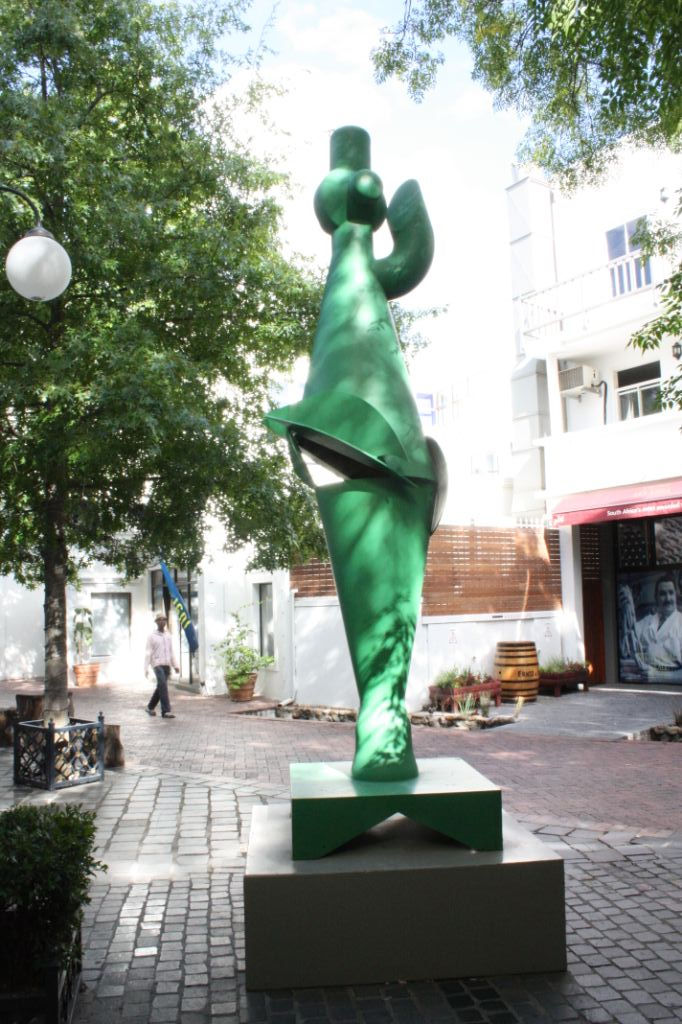
Edoardo Villa
Italy
B. 1915
Edoardo Daniele Villa was born in the village of Redona, on the outskirts of Bergamo, Italy in 1915. He studied the basic techniques of sculpture at the Scuola d’Arte Andrea Fantoni, under the sculptors Minotti, Lodi and Barbieri. As a young artist, he completed a number of public commissions for reliefs in his home town. Villa was about to continue his art studies in Milan when he was called up for two years of military service. He asked to be stationed in Rome, which gave him the opportunity to view the numerous public sculptures on display throughout the city (Von Maltitz and Nel, 2005). With the outbreak of the Second World War, Villa was conscripted into the Italian army under Mussolini and was wounded in the North African campaign. He was captured by English forces and hospitalised in Egypt before being sent to South Africa as a prisoner-of-war. Together with 70,000 Italians, he was held at the Zonderwater camp in the Transvaal from 1942. During the four years in the POW camp Villa was able to start sculpting again (Berman, 2005). An art studio and a number of cultural activities for the young prisoners were set up in the camp, and the years spent there were an active period of re-connecting with his craft. He studied the work of Auguste Rodin, working mainly in plaster-of-Paris. The difficult conditions of the war years was reflected in his work, described by Von Maltitz and Nel (2005) as “emotional” and descriptive in style. Esmé Berman (2005) notes that, “Rodinesque realism characterised the first phase of Edoardo Villa’s South African career.”